What is an AMErican?
KATELYN MORIMOTO

What is an American? Nowhere in any of our country's founding documents is there a clear description of what the ideal American looks like in terms of appearance. Based on the Declaration of Independence, we can understand that "all [Americans] are created equal, that they are endowed by their Creator with certain unalienable Rights, that among these are Life, Liberty, and the pursuit of Happiness." But my family, though American in those exact principles, was detained under the pretense of being a spy for the Japanese government and aiding a country that they were not even born in. The history surrounding Japanese internment is highly similar to current events, with Immigration and Customs Enforcement (ICE) detaining people of color without reasonable cause, simply due to the fear that they might be undocumented or illegal. Being an American is not something that one person or group should decide. The United States of America, as a country, has concepts of equality, liberty, and the pursuit of happiness. Therefore, it would not be unreasonable to assume that being American is more of a state of mind, and less about the appearance of a person.
Through my education at Otis, I have come to understand the true power of storytelling that exists in both animation and the real world. Without the stories and history that have been passed on through my family, the current events surrounding the detainment of immigrants might not have been as impactful for me. Since the sites of the Japanese internment camps are reported to be reopened, it brings about the question of how we can define the legitimacy of being an American. According to Claire Wang, journalist for The Guardian, "over the past two weeks, local activist groups said they’ve observed Immigration and Customs Enforcement (ICE) vehicles entering and exiting Terminal Island, using a federal prison and coast guard facility to prepare for ongoing actions around Los Angeles county"(July 16, 2025). This has led me to question recent events and wonder how I, or my fellow Americans, can pursue our own sources of happiness with the freedom we are entitled to as people residing in this country.
Unfortunately such practices of involuntary relocation are still happening today, and the selection process is not based on any characteristic that an individual can control. It is based solely on race. When my paternal grandfather, Stanley Morimoto, was a young boy, he remembers his father growing beautiful camellias. He spent years preparing different varieties and sizes, taking care of each one with great precision. There were a variety of colored pots for each growth cycle of the plant, and delicate plastic coverings served as a personal greenhouse for each plant. My great-grandfather's dream was to open a nursery. He wanted to provide a source of beauty and carefully cultivated greenery for his community. Sadly, this dream was cut short in the 1940s. He was nearly ready to sell his inventory to others when Pearl Harbor was attacked. Within a day, my grandfather watched his dad sell hundreds of flowers they owned for a few dollars to a local nursery, and my family's dreams of raising flowers slowly came to an end. Sadly, my family was not alone in this, as thousands of other Japanese families were forced to relinquish almost all of their assets as they were given days to find a way to fit all of their lives into a suitcase.

In February 1942, shortly after the attack on Pearl Harbor, President Franklin D. Roosevelt signed Executive Order 9066, authorizing the forced removal of Japanese Americans from the West Coast. Within months, over 110,000 individuals, two-thirds of them U.S. citizens, were removed from their homes and placed into incarceration camps scattered across remote parts of the country. The evacuation unfolded rapidly and with devastating effects. Families were given just days to pack their belongings, often limited to what they could carry in a suitcase.
Businesses, farms, and homes were abandoned or sold under duress, leaving families destitute. Some families even stayed in the camps for as long as they could, since they had nowhere to return to. Many businesses were forced to mark down items at extremely low prices in an attempt to mitigate the substantial monetary losses they would likely incur. Shortly after the announcement of Executive Order 9066, the Seattle Times reported on the 'removal sales' that Japanese Americans conducted to try to mitigate some of the monetary losses ahead.
Notice put out by the US Government in 1942. (Toyo Miyatake Studios)
In this, they note that white Americans intended "to buy the Japanese owner's stock at 5 or 10 cents on the dollar, now that the Japanese are faced with evacuation" (Seattle Times 1). Yoshimi Matsuura's family had to sell their vineyards for a total of $23/acre, instead of the $200/acre they would have netted if they had been allowed to stay and harvest the grapes themselves. And Mitsuko Hashiguchi recalled what happened after Western Farm Incorporated promised to run her family farm (Varner).

“They said they will harvest everything and take care of it for us and will send us the money when they get it all harvested and all this, things that go with it. And I think the government must have stepped in later because I heard that’s all they did was harvest just the strawberries and peas out of the field and whatever they did with it… they must have sold it or whatever they did. After that nothing was done to the field. They did not touch it again or do anything out there, and they ransacked all the houses.”
-Mitsuko Hashiguchi (Varner)
On December 8, 1941, the owner of this Oakland, California, store, a UC graduate, posted this sign. (Library of Congress)
Official justifications centered on fears of espionage and sabotage, though little evidence supported these claims. Instead, the policy reflected a combination of wartime hysteria, racism, and economic opportunism. Many figures of authority in the United States began to make jarring statements that instilled fear and ideas of segregation in the public. Notably, Lt. General John L. DeWitt, the head of the U.S. Army's Western Defense Command in 1942, was a strong advocate of Executive Order 9066. During the spring of 1943, many Japanese Americans began to volunteer their services in World War 2, which led to the general public starting to believe that the Japanese should be permitted to go home (Walker). In response to this, DeWitt gave a testimony before a subcommittee of the House Naval Affairs Committee, where he said the following:
"The development of a false sentiment on the part of certain individuals and some organizations to get the Japanese back on the West Coast. I don’t want any of them here…As far as I am concerned I am not concerned with what they do with the Japanese as a whole just so they are not allowed to return to the West Coast. My superiors know I consider it unsafe to do so.
…The danger of the Japanese was, and is now, -if they are permitted to come back- espionage and sabotage. It makes no difference whether he is an American citizen, he is still a Japanese. American citizenship does not necessarily determine loyalty"
-Lt. General John L. DeWitt (Walker)
The nature of what happened to the Japanese Americans reveals more than individual prejudice. DeWitt's statement here is a perfect example of the contradictions within the government regarding the understanding of who is considered an American. It illustrates how racism was embedded in the laws and decisions that shaped everyday life. The National Library of Medicine has an article written by Donna K. Nagata who debates Critical Race Theory(CRT) and its relation to the Japanese internment camps. CRT helps us see this clearly by showing that racism is not only about personal actions, but also about the systems that determine who is protected and who is vulnerable (Nagata et al., 2019). Executive Order 9066 was not simply a response to wartime fear. It was a legal decision that treated an entire community as suspicious because of their ancestry or place of origin.
The result of this decision is still felt in the lives of families like mine, who were uprooted not because of anything they had done, but because the government decided they could not be trusted based on their ancestry or place of origin. It was within this system, built on fear and shaped by race, that my relatives entered the camps and began to experience the hardships that would define their daily lives. Merriam-Webster Dictionaries defines concentration camps as "a place where large numbers of people (such as prisoners of war, political prisoners, refugees, or the members of an ethnic or religious minority) are detained or confined under armed guard". According to this definition, the "internment" that the Japanese people faced in the 1940s was actually a concentration camp.
Conditions in the camps were harsh. Nagata notes that many families “were forced to live in a single room furnished only with cots, a coal-burning stove, a single ceiling light bulb, and no running water” (Nagata et al., 2019). The barracks were extremely barren, and many camp sites were located in places with extreme temperatures. One of the few things Stanley can remember about Manzanar is how strong the wind was. There was an instance where he had attempted to close the door to their barracks, but he was so small that the wind blew him and the door straight out of the doorframe. My grandfather also speaks of the sounds the wind would make as it passed through the cracks in the walls, and how his mother and other women tried to hang cloth and move suitcases to help keep out the chill of winter. Makeshift barracks, communal latrines, and poor sanitation defined daily life. Residents attempted to maintain a sense of community through schools, newspapers, and even cultural activities, but the confinement remained a constant reminder of their second-class treatment.

Detainees in their quarters at at the repurposed Santa Anita horse-racing track in Arcadia, California. (Mark Kauffman/Getty Images)
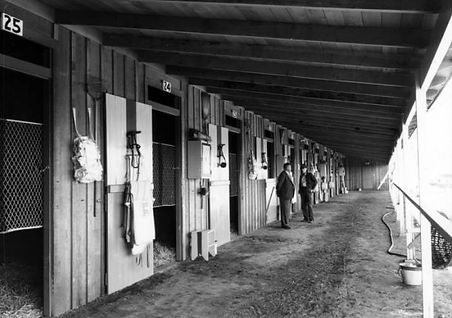
The Santa Anita Racetrack horse stalls, (Los Angeles Public Library Photo Collection)
What seemed like an adventure to children was actually a profound moment of loss for their parents, who had just had their way of life taken from them. George Takei shared his family's incarceration at Santa Anita Racetrack, "Each family was assigned a horse stall still pungent with the stink of manure” (Zhaniser). Children in camps spent more time with peers than with family, and traditional gender roles started to shift as fathers lost their breadwinner status while mothers had to take on similar low-wage jobs. Camp rules also required English to be used for transactions and limited some participation to U.S. citizens. This gave bilingual Nisei (Second Generation) more authority than their Issei (First Generation) elders, which created intergenerational tensions and made the Sansei (Third Generation) navigate a tense community (Nagata et al., 2019). In Japanese culture, it is customary to respect one's elders, especially in a context like this, where it is a matter of advocating for the community.

My great grandfather, featured in the top row fifth from the left, with some of the kitchen staff in the camp in Jerome. (Tom & Kiyoko Sasaki)
Although my maternal grandmother can't remember much of her time at Santa Anita Racetrack, her parents described it in the same way. Kiyoko Takeuchi was born in Long Beach, California. Her father had come to Long Beach from Hiroshima, Japan, but most of his family was in Hawaii. Kiyoko's family stayed with a Caucasian family and was involved in the grocery business. Her family was sent to Santa Anita Racetrack in April 1942 and then to Arizona (Poston) and Arkansas (Jerome), where her younger sister was born in 1943. My grandma remembers a train ride on her return from Arkansas to Arizona. It was dark in the train, and the shades were drawn down all the way. Kiyoko remembers being scolded because she had wanted to see what was outside. Apparently, everyone had been told to keep the shades down to avoid being caught. When she was at Jerome, her family was in block five. Her father earned $16 a month as an ambulance driver, and later, he secured work in the kitchen for a salary of $81 a month. It was in Arkansas that men handcrafted items from hyootan, a gourd and wood found in the area. Kiyoko's father was notably an artist, and still found ways to create amidst the chaos of the war.

My grandmother, Kiyoko Sasaki and her parents in Poston. (Tom & Kiyoko Sasaki)

The living quarters at the War Relocation Camp in Poston, Arizona. (NSF / ALAMY)
My paternal grandmother, Evelyn Morimoto, and her family moved to Colorado to escape the reach of Executive Order 9066. She speaks of the struggles her family faced during that time, being one of only two Japanese families in the city. Evelyn was brilliant and a model student, so much so that she was awarded head girl in high school. However, despite being kind and popular, boys never asked her to dance, and friends never invited her over. For predominantly white areas, her family, though successful, was not trusted by their community. Nagata mentions this concept where they state that the “exclusion of Japanese Americans from mainstream society paved the way for a swift response following Pearl Harbor, with little objection from others (Nagata et al., 2019). Many people in the area knew little about the war, and televisions or ways to receive information were not so easily found. People lived in fear. They did not know if the Japanese were to be trusted or could ever be.

The barracks of Manzanar in California. (Toyo Miyatake Studios)

My maternal granfather, Tamao Sasaki near the steps of a barrack in Manzanar. (Tom & Kiyoko Sasaki)
By December 1944, the Supreme Court ruled in Ex parte Mitsuye Endo that the government could not detain loyal citizens without cause, effectively ending the internment policy (Horne). However, the last camp did not close until March 1946, and the scars of displacement lingered long afterward. But what do these scars really look like in a 21st-century family? Kiyoko and Tom Sasaki lean into a more typical Japanese mentality and are willing to speak out about the memories from camp. Although they both remember the camp as a somber time, there is an understanding that their families did all they could to make the best of the situation. With them, I learned the importance of perseverance and to stand firm in the face of adversity and unfairness. There are traditional Japanese Kachikans, which are "shared core values passed through generations that our ancestors, the Issei pioneers, brought with them from Japan," according to the Japanese Cultural Center of Hawaii. I grew up being taught these principles, and they are reflected well in how Kiyoko and Tom chose to tackle the war trauma. Gaman and Ganbari stand for "quiet endurance" and "persistence", which have both been imbued in the Japanese American experience when it comes to how many of us speak of the "internment camps", which should actually be referred to as concentration camps (Japanese Cultural Center of Hawaii).
The legacy of these actions extends beyond the memories of families like mine. It continues to echo in the present. Today, marginalized communities still face policies shaped more by fear than by fact. ICE raids and detentions often rely on suspicion rather than evidence, and they disproportionately target Latino and Asian communities. In some cases, U.S. citizens have been detained simply because their appearance, language, or documentation did not seem "American enough." These moments reveal how fragile the idea of American identity becomes when racial bias goes unchallenged.
At the same time, efforts to restrict or ban the teaching of Critical Race Theory reflect a discomfort with facing the more complex truths of our history. This discomfort mirrors the way the government once softened the language around the incarceration of Japanese Americans by calling the camps "internment" rather than recognizing them as concentration camps. Today's resistance to CRT works similarly by attempting to erase or soften the role that racism has played in shaping American laws and institutions (Nagata et al., 2019). When we limit the teaching of the systems that allowed something like Executive Order 9066 to exist, we make it easier for similar injustices to take root.
Understanding this history is not about placing blame. It is about recognizing patterns. In the 1940s, racism made it possible for the government to suspend the rights of an entire community because of their ancestry. Racism today still influences who is viewed as suspicious, foreign, or unsafe. The same thinking that once justified removing Japanese American families from their homes can be seen now in the border detentions without due process, and rhetoric that paints certain groups as inherently untrustworthy. After the 2016 Presidential Election, Carl Higbie, the former Director of Advocacy for America First Policies, made a suggestion that the then President Elect, Donald Trump, might consider using similar detainment policies with Muslims that could be comparable to the Japanese concentration camps (Hallett, 2017). As of September 8th 2025 the Supreme Court ruled in favor of the Vasquez Perdomo v. Noem case in a 6-3 vote. This ruling as stated by the American Immigration Council, “gives immigration agents a “green light” to once again stop anyone they guess to be here illegally—even if a central reason for the stop was race” (September 9, 2025).
The implications are clear. When a society refuses to confront its past, it becomes vulnerable to repeating the mistakes of the past. Acknowledging the systemic nature of racism is one way to protect the principles the nation claims to uphold, including equality, liberty, and the pursuit of happiness. My family's story is not an isolated moment from long ago. It serves as a reminder that civil rights must be cherished and defended in every generation. Only by facing the truth through education, storytelling, and honest reflection can we build a country where being American is defined by shared values rather than race, appearance, or ancestry.
Process
While studying at Otis College of Art and Design, I have enjoyed being part of the Digital Media department. As an animation major, I've learned how to use personal emotions as inspiration for visual stories, and this project let me explore that further. I create a lot of my work by combining personal stories with accurate cultural details. I usually start with old conversations, sketches, and ideas that slowly come together into a full story. When I began this storyboard, I thought about how I could create something that was both technically sound, while still maintaining the integrity of my culture and its history.
One of the things that has stuck with me throughout my education at Otis is that storytelling is not limited to written words. As artists we are able to use concepts like line, color, and adjust the pacing or mood of the story to convey a unique story for the viewer. With this understanding in mind, my creative process began with thumbnail sketches. These small and rapid drawings allowed me to visualize how moments of fear, resilience, displacement, and hope might unfold cinematically. I made thumbnails that helped me map out the flow of the story. Though I honestly had a difficult time figuring out how to properly convey the quiet resilience that families faced in camps, or the generational trauma that still lingers in my family today.

At this point of my process I wanted to add a way to aid the transition, and was reminded of origami, which is a hobby that consists of folding paper into art. I liked the idea of using a form of creativity that relied on precision and discipline as a medium to shift between the past and the present. The viewer is led through the story as the characters fold a paper crane together, making the time jumps a little easier to follow.

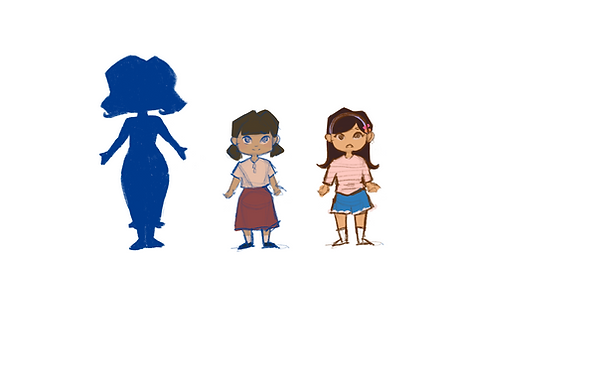
Since the history of Japanese American concentration camps is often downplayed or not mentioned in our education, I felt that the characters in my storyboard needed to be honest and easy for the viewer to understand. Also, considering that I was on limited time, I decided to create simplistic designs. I wanted the characters to be appealing, but overall I imagined this to be story driven rather than just aesthetically pleasing. Simplified silhouettes and clear facial shapes allow viewers to focus on the feelings of the story such as the fear of losing everything you own or strength required to persevere through adversity.
.png)
.png)
Once I completed thumbnails that I liked, I expanded them into the first pass of rough storyboards. This stage helped me refine the tone and overall rhythm of the storyboard. I used the rough boards to determine how to switch between the past and present, how to communicate contradictions within the idea of American identity, and how to highlight the parallels between the incarceration of the 1940s and many detention practices that still exist today. For the opening scene, I aimed to create the sense of a memory suspended in time to show how trauma remains long after the event itself. I also planned to use color to emphasize emotional shifts between the present, which is a more resolved and warm tone, and the past, which has a more somber and heavy tone that reflects the memory my character recalls.


I also had the opportunity to explore some concepts for backgrounds. During this I used Photoshop to rough out some main areas that I could use in a potential animation, and incorporated the colors from the moodboards above.

.png)
.png)
During this stage of the process, I had a conversation with one of my professors. They encouraged me to consider expanding this project into a short film in the future. Their advice pushed me to think more carefully about how each visual choice contributes to the political and emotional goals of the work. If I choose to develop this project further, the storyboard will serve as the structural foundation for a larger piece that honors my family's history and confronts the systems that continue to threaten the dignity and rights of marginalized communities today.
STORYBOARD
internal
Works Cited
“Concentration Camp Definition & Meaning.” Merriam-Webster, www.merriam-webster.com/dictionary/concentration%20camp. Accessed 12 Nov. 2025.
“Declaration of Independence: A Transcription.” National Archives, National Archives and Records Administration, www.archives.gov/founding-docs/declaration-transcript. Accessed 20 Oct. 2025.
Horne, Madison. “Harsh Reality of Life in WWII Japanese American Internment Camps.” History.com, A&E Television Networks, 2 Sept. 2025, www.history.com/articles/japanese-internment-camp-wwii-photos. Accessed 3 Oct. 2025.
“Kachikan Values.” Japanese Cultural Center of Hawaiʻi, www.jcchawaii.org/resources/kachikan-values. Accessed 12 Nov. 2025.
Walker, Alan. “A Slap’s a Slap: General John L. DeWitt and Four Little Words.” The Text Message, National Archives and Records Administration, text-message.blogs.archives.gov/2013/11/22/a-slaps-a-slap-general-john-l-dewitt-and-four-little-words/. Accessed 5 Sept. 2025.
Wang, Chloe. “Ice Activity on Historic Japanese Site Evokes Painful Legacy of Incarceration.” The Guardian, Guardian News and Media, 16 July 2025, www.theguardian.com/us-news/2025/jul/17/los-angeles-ice-raids-japan-terminal-islands. Accessed 10 Nov. 2025.

Annotated Bibliography
Hallett, Miranda. “Internment, Immigrant Detention, and the Imagined Imperiled Whiteness of U.S. Citizenship.” PBS SoCal, 20 Jan. 2017, www.pbssocal.org/shows/link-voices/internment-immigrant-detention-and-the-imagined-imperiled-whiteness-of-u-s-citizenship. Accessed 21 Nov. 2025.
[Author Credentials]
Dr. Miranda Cady Hallett is an anthropologist and public scholar. She has done extensive ethnographic research, particularly around Latin American immigrant communities, citizenship, labor, and racial exclusion in the U.S.
[Audience/Type of Information]
This essay is written for a general but informed audience. This includes community members, students, educators, and those interested in immigration, race, and U.S. history. It’s a thoughtful public commentary piece, not an academic journal article.
[Purpose / Bias / Point of View]
Hallett argues that current immigration enforcement and detention practices echo the racial others-making at work in the WWII internment of Japanese Americans. Her point of view is strongly shaped by anti-racism, racial justice, and the critique of white supremacy. She frames U.S. citizenship and racialized exclusion as deeply intertwined with historically white-supremacist structures.
[Currency of the Source]
Published in January 2017, the piece draws on both historical memory and contemporary concerns about immigration enforcement. While a few years old, its themes remain highly relevant particularly around debates of race, enforcement, and belonging.
[Coverage/Scope/Content]
Hallett connects the internment of Japanese Americans during WWII with present-day immigrant detention, arguing that both systems are expressions of a racialized, Eurocentric vision of citizenship. She discusses otherness, "white-majority nation” logic, and how racialized threat narratives enable exclusion. She brings in social theory and historical context, including the “yellow peril” and racial hierarchies, to critique modern immigration policy.
[Relevance to Paper]
This source is very useful if your paper explores themes of race, citizenship, state power, and the legacies of internment. It provides a bridge between historical injustice and present-day policy, allowing you to draw connections between past and contemporary systems of oppression. If you're writing about the long-term legacy of incarceration, how white supremacy has shaped U.S. citizenship, or if you're analyzing current immigration policy, Hallett’s argument will add strong conceptual support.
Nagata, Donna K., Jackie H. J. Kim, and Teresa U. Nguyen. “The Japanese American Wartime Incarceration: Examining the Consequences of a Race-Based War.” Transcultural Psychiatry, vol. 56, no. 1, 2019, pp. –, PMC, PMC6354763, https://pmc.ncbi.nlm.nih.gov/articles/PMC6354763/. Accessed 19 Nov. 2025.
[Author Credentials]
Donna K. Nagata is Professor of Psychology at the University of Michigan, with a PhD in Clinical Psychology; her research focuses on Asian American mental health and trauma. Jackie H. J. Kim and Teresa U. Nguyen are psychologists whose work with Nagata explores intergenerational, sociocultural outcomes of the WWII incarceration of Japanese Americans.
[Audience/Type of Information]
Scholars and students of psychology, Asian American studies, sociology, and history; this peer-reviewed journal article offers empirical analysis and theoretical insight into wartime incarceration, trauma, and intergenerational effects.
[Purpose / Bias / Point of View]
The authors approach the wartime incarceration of Japanese Americans through a psychological and trauma-informed lens. They emphasize the long-term consequences and cultural trauma endured by those incarcerated and their descendants. While the piece is academic and evidence-based, it implicitly supports perspectives on redress, healing, and the ongoing legacy of injustice.
[Currency of the Source]
Published in 2019, this source is relatively recent for scholarship on WWII incarceration and integrates modern trauma research and sociocultural frameworks, making it highly usable for current analysis.
[Coverage/Scope/Content]
The article examines how the forced removal and incarceration of Japanese Americans during WWII acted as a race-based cultural trauma. It covers individual coping responses, family communication, identity changes among the Nisei (second generation), and intergenerational impacts on Sansei (third generation). It uses survey data and interviews to explore how the trauma has persisted socially and psychologically.
[Relevance to Paper]
This article provides rigorous theoretical and empirical grounding for discussions around trauma, identity, cultural memory, and the multigenerational legacy of incarceration. If your paper focuses on psychological, intergenerational, or trauma-based dimensions of Japanese American incarceration, this source will be particularly valuable for supporting your arguments.
Varner, Natasha. “Sold, Damaged, Stolen, Gone: Japanese American Property Loss during WWII.” Densho, 4 Apr. 2017, densho.org/catalyst/sold-damaged-stolen-gone-japanese-american-property-loss-wwii/. Accessed 10 Nov. 2025.
[Author Credentials]
Natasha Varner is a historian and the Communications and Public Engagement Director at Densho, an organization dedicated to preserving Japanese American incarceration history. She holds a PhD in History from the University of Washington. Her work focuses on race, migration, public history, and the politics of memory, with an emphasis on Japanese American and Latin American wartime histories.
[Audience/Type of Information]
General readers, students, educators, historians, and researchers seeking accessible but historically grounded information about Japanese American incarceration, especially economic and material consequences.
[Purpose / Bias / Point of View]
Varner writes from a historical and social-justice–oriented perspective, emphasizing the scale of financial devastation inflicted on Japanese Americans through forced removal, theft, property loss, and discriminatory policies. The piece aims to correct sanitized narratives and highlight state responsibility. As a Densho publication, it has an implicit mission-driven stance toward preserving memory and advocating historical accountability.
[Currency of the Source]
Published in 2017, the article reflects recent historical scholarship on incarceration and incorporates updated archival materials and community testimonies. It remains current because it addresses long-term economic impacts that continue to shape Japanese American generational wealth.
[Coverage/Scope/Content]
The article examines different forms of property loss in homes, farms, businesses, personal belongings. This shows how systemic racism and wartime policies enabled widespread dispossession. Varner draws on archival records, testimonies, and economic studies to illustrate how damages were often minimized or ignored by wartime agencies. She also connects property loss to broader patterns of racialized economic exclusion in U.S. history.
[Relevance to Paper]
This source is valuable for demonstrating the material and economic dimensions of incarceration, complementing sources that focus on psychological or cultural trauma. If your paper discusses injustice, reparations, loss of wealth, or structural racism, Varner's article provides specific examples, historical context, and evidence of long-term consequences.
Zhaniser, J.D. “Japanese Internment Camps: America’s Great Mistake.” HistoryNet, 10 Jan. 2023, www.historynet.com/japanese-internment-camps-wwii/. Accessed 23 Sept. 2025.
[Author Credentials]
J.D. Zhaniser is a writer and historical researcher who contributes to HistoryNet, a long-running magazine and digital platform specializing in military and U.S. history. While formal academic credentials are not publicly listed, Zhaniser regularly produces historically grounded articles that synthesize archival material and scholarly research for a broad readership.
[Audience/Type of Information]
General readers, students, and enthusiasts of U.S. history who want a clear, narrative overview of Japanese American incarceration. The article is designed for a non-academic audience but draws on credible historical accounts and secondary scholarship.
[Purpose / Bias / Point of View]
The article adopts a critical stance toward the U.S. government's actions during WWII, asserting that incarceration was a profound moral and political error. The tone reflects a retrospective condemnation of wartime racism and civil liberties violations. While not explicitly activist, the piece frames incarceration as a cautionary tale and strongly emphasizes injustice which is an interpretive bias aligned with modern historical consensus.
[Currency of the Source]
Published in 2023, the article is recent and reflects contemporary historical interpretations that integrate decades of research, survivor testimony, and government documents. It incorporates current framing around human rights and constitutional violations.
[Coverage/Scope/Content]
Zhaniser provides a broad historical overview, including events leading up to Executive Order 9066, the forced removal process, living conditions in camps, and eventual government acknowledgment of wrongdoing. The article focuses on major themes such as racism, wartime hysteria, loss of rights, and public opinion and includes details that situate incarceration within larger patterns of discrimination in U.S. history.
[Relevance to Paper]
This article is useful for establishing a clear narrative foundation of what happened and why it is considered a national failure. If your paper discusses civil liberties, wartime racism, or government accountability, Zhaniser’s article supplies accessible context, summary information, and thematic framing that can support broader analytical arguments.